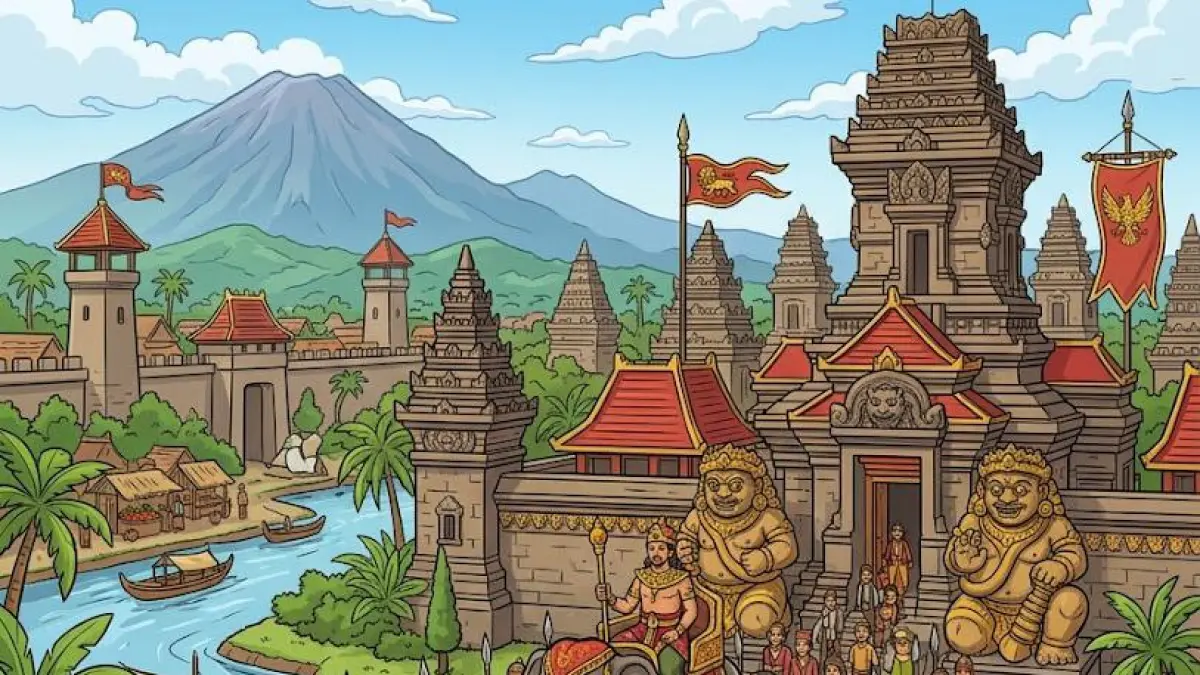
JAKARTA – The Singhasari Kingdom history traces the rise of a powerful Hindu-Buddhist state in East Java from its founding by Ken Arok to its dramatic collapse in 1292, an event that reshaped regional power and directly led to the emergence of Majapahit.
The Singhasari Kingdom history highlights a kingdom built on ambition and conflict, where dynastic struggles and strategic expansion defined its trajectory. From its origins as Tumapel to its peak under Kertanagara, the kingdom played a critical role in shaping early Indonesian political and maritime networks.
For historians, the Singhasari Kingdom history is essential to understanding how power transitioned from local Javanese polities into a wider regional empire.
The Founding of Singhasari and Ken Arok’s Violent Rise
The Singhasari Kingdom began as Tumapel, a region under the influence of the Kadiri Kingdom. According to the Pararaton, its founder Ken Arok rose from humble origins, reportedly born to a farmer’s family but associated in myth with divine lineage.
Ken Arok’s early life was marked by instability and wandering, before he entered the service of Tumapel’s ruler, Tunggul Ametung. His ascent to power came through assassination: he killed Tunggul Ametung using a kris forged by Empu Gandring, then married Ken Dedes, the ruler’s wife.
Backed by Brahmins dissatisfied with Kadiri’s ruler Kertajaya, Ken Arok led a rebellion and defeated Kadiri around 1222. He then established himself as the first ruler of Singhasari, adopting royal titles such as Sri Rajasa Batara Sang Amurwabumi.
Baca Juga: Moto3 Indonesia 2026 Jadi Sorotan Dunia, Veda Ega Pratama Bawa Harapan Baru di Grand Prix
However, his reign lasted only 25 years. In 1247, he was assassinated by Anusapati—Tunggul Ametung’s son—marking the beginning of a cycle of revenge killings that would destabilize the dynasty.
Expansion, Internal Conflict, and Kertanagara’s Golden Era
Following Ken Arok’s death, Singhasari experienced rapid leadership changes. Anusapati ruled from 1247 to 1249 before being killed by Tohjaya, Ken Arok’s son. Tohjaya’s rule was short-lived, as he was overthrown by Wisnuwardhana and Narasingamurti.
Under Wisnuwardhana—also known as Ranggawuni—the kingdom entered a more stable phase. He ruled for approximately 22 years and relocated the political center from Tumapel to Singhasari, solidifying the kingdom’s identity.
According to historical accounts, Wisnuwardhana also strengthened internal defenses and suppressed rebellions, including a notable uprising in 1252. His reign laid the groundwork for Singhasari’s expansion.
Baca Juga: Veda Ega Pratama Jadi Harapan Baru Indonesia, Mampukah Tembus Moto3 hingga MotoGP?
The kingdom reached its peak under his successor, Kertanagara, who ruled from the mid-13th century until 1292. Kertanagara pursued an ambitious vision of regional unification, launching the Pamalayu expedition in 1275 to expand influence over Sumatra.
Under his leadership, Singhasari extended its reach across parts of Java, Bali, and beyond, while also strengthening diplomatic ties, including with the Kingdom of Champa. He also promoted religious syncretism, blending Siwa and Buddhist traditions.
However, his assertive policies created internal tensions. Officials who opposed his agenda, such as Mpu Raganata and Arya Wiraraja, were demoted or reassigned—moves that later contributed to political unrest.
Collapse of Singhasari and the Rise of Majapahit
The fall of Singhasari was triggered by both external threats and internal dissent. In 1289, Kublai Khan sent envoys demanding tribute. Kertanagara’s response was defiant—he reportedly humiliated the envoy, escalating tensions with the Mongol Empire.
Three years later, in 1292, rebellion erupted from within. Jayakatwang, a regional ruler linked to the former Kadiri dynasty, launched a coordinated attack while Singhasari’s forces were deployed elsewhere.
The assault succeeded. Kertanagara was killed at his palace, along with key officials, effectively ending the Singhasari Kingdom after around 70 years of rule.
Baca Juga: Beras Murah Diserbu Warga dalam Gerakan Pangan Murah Pucanglaban Tulungagung 2026
Yet the story did not end there. Raden Wijaya, Kertanagara’s son-in-law, fled and regrouped. In 1293, he allied temporarily with Mongol forces sent by Kublai Khan to punish Singhasari.
After defeating Jayakatwang, Raden Wijaya turned against the Mongols and expelled them from Java. He then founded the Majapahit Kingdom, establishing a new political order while claiming lineage from Ken Arok’s Rajasa dynasty.
Enduring Legacy of Singhasari
The Singhasari Kingdom history remains a cornerstone of Indonesia’s early state formation. Despite its relatively brief existence from 1222 to 1292, the kingdom demonstrated how regional power could expand through both military and maritime strength.
Baca Juga: Hiroshi Aoyama Honda Jadi Kunci Kebangkitan Pembalap Asia, Veda Ega Pratama Masuk Sorotan Besar
Its legacy survives in historical texts such as Pararaton and Nagarakretagama, as well as archaeological remains across East Java. More importantly, its سقوط (collapse) directly enabled the rise of Majapahit, which would later dominate much of Southeast Asia.
As one chronicle suggests, “power built on ambition must also face its consequences”—a reflection of the turbulent yet transformative legacy of Singhasari.
Editor : Axsha Zazhika