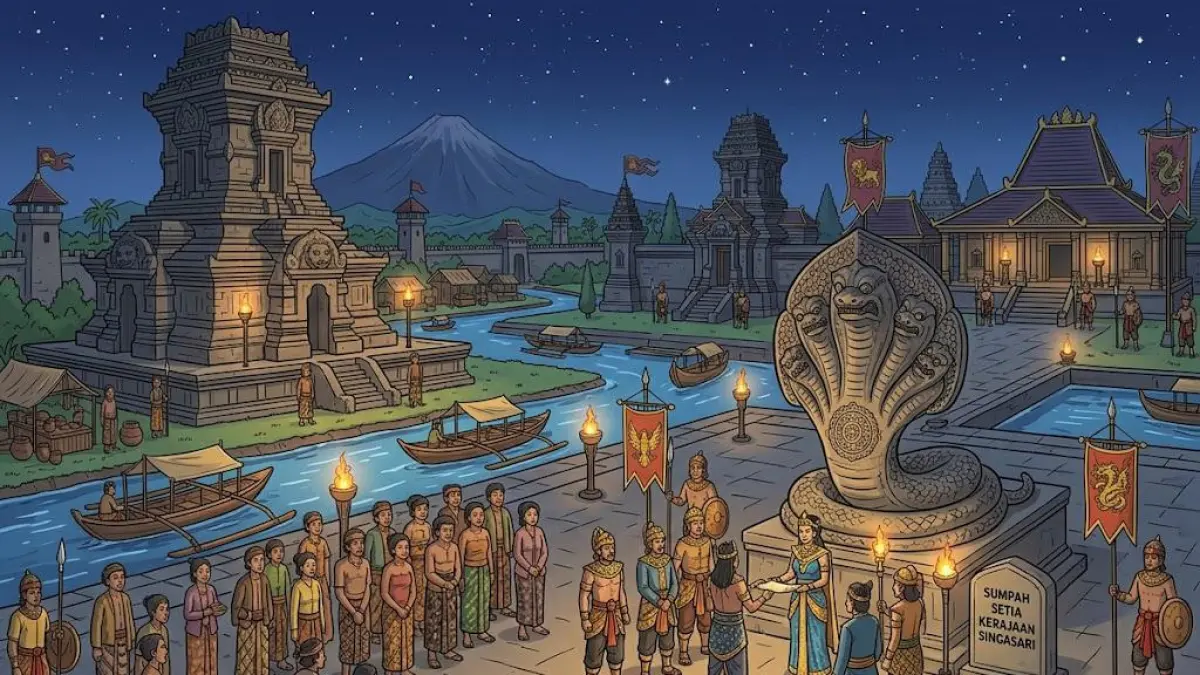
JAKARTA – The Singasari Kingdom history reveals a dramatic tale of power, betrayal, and myth, beginning with the rise of Ken Arok in 1222 AD, whose calculated seizure of power in East Java laid the foundation for one of the most influential Hindu-Buddhist kingdoms in Southeast Asia.
The Singasari Kingdom history is deeply intertwined with the controversial figure of Ken Arok, a man of obscure origins who rose to become king after overthrowing local ruler Tunggul Ametung. His ascent, marked by political manipulation and violence, remains one of the most debated origin stories in Indonesian historiography.
In early accounts such as the Pararaton, the Singasari Kingdom history is depicted not only as a political narrative but also as a myth-laden chronicle, blending divine lineage, prophecy, and a legendary cursed weapon—the keris of Mpu Gandring.
The Strategic Rise of Ken Arok
Ken Arok’s path to power was far from conventional. Initially known as a commoner—often described as a gambler and outlaw—he strategically positioned himself within the political structure of Tumapel, a subordinate region under the Kediri Kingdom.
Historical sources indicate that Ken Arok gained influence after entering the service of Tunggul Ametung, the local ruler. However, driven by ambition and his desire for Ken Dedes, Ametung’s wife, Ken Arok orchestrated his assassination using a keris forged by Mpu Gandring.
According to the Pararaton, the killing was not a straightforward act. “He used another’s hand,” the chronicle suggests, indicating a calculated attempt to conceal his direct involvement. Shortly after Ametung’s death, Ken Arok married Ken Dedes and assumed control of Tumapel.
Baca Juga: Moto3 Indonesia 2026 Jadi Sorotan Dunia, Veda Ega Pratama Bawa Harapan Baru di Grand Prix
By 1222 AD, with the support of Brahmins who opposed Kediri’s King Kertajaya, Ken Arok defeated Kediri forces and declared the establishment of the Singasari Kingdom. He adopted the royal title Sri Rajasa Bhatara Sang Amurwabhumi, marking the beginning of the Rajasa Dynasty.
Myth, Power, and the Curse of Mpu Gandring
The Singasari Kingdom history is inseparable from the legend of Mpu Gandring’s cursed keris. Historical narratives state that Ken Arok killed the blacksmith before the weapon was completed, prompting a curse that foretold the deaths of seven generations using the same blade.
This prophecy appeared to unfold rapidly. Ken Arok ruled for approximately 25 years before being assassinated in 1247 by Anusapati, the son of Tunggul Ametung and Ken Dedes. The weapon used was reportedly the same cursed keris.
Baca Juga: Honda Team Asia Makin Diperhitungkan, Tim Pembinaan Asia yang Siap Lahirkan Bintang MotoGP
Anusapati’s reign, however, was short-lived—lasting only about two years before he was killed by Tohjaya, Ken Arok’s son from another marriage. The cycle of revenge continued, reinforcing the narrative that the curse was real.
Physical evidence linked to this turbulent era includes Candi Kidal in Malang, widely believed to be the funerary temple of Anusapati. While no direct inscription confirms this, both the Pararaton and Nagarakretagama reference his association with the site, strengthening its historical credibility.
Stability, Expansion, and Cultural Legacy
After years of internal conflict, stability emerged under Ranggawuni, also known as Wisnuwardhana, who ascended the throne following Tohjaya’s fall. His reign marked a turning point in the Singasari Kingdom history, shifting from internal bloodshed to consolidation and development.
Baca Juga: Hiroshi Aoyama Honda Jadi Kunci Kebangkitan Balap Asia, Strategi HRC Mulai Terlihat di MotoGP 2026
Ranggawuni ruled for decades—some sources cite up to 41 years—and focused on strengthening governance and economic infrastructure. Historical texts mention the development of Canggu port in Mojokerto, which played a critical role in expanding maritime trade networks.
During this period, Singasari also demonstrated religious syncretism, blending Hindu and Buddhist traditions. This is reflected in Candi Jago, a temple associated with Wisnuwardhana, which features both Buddhist and Hindu reliefs, illustrating a period of relative harmony.
The kingdom’s prosperity and territorial expansion would later reach its peak under Kertanegara, although that phase ultimately led to external conflict and internal vulnerability.
Baca Juga: Moto3 Indonesia 2026 Makin Menggila, Veda Ega Pratama Bikin Dunia Balap Mulai Melirik Indonesia
A Legacy Defined by Power and Intrigue
The Singasari Kingdom history stands as one of the most complex chapters in Indonesia’s past, shaped by ambition, betrayal, and cultural transformation. From Ken Arok’s calculated rise to the سلسلة of assassinations that followed, the dynasty’s early years were marked by instability and legend.
Yet, despite its violent beginnings, Singasari laid the groundwork for the Majapahit Empire, which would later dominate the region. As noted in ancient chronicles, “the lineage of Rajasa continued,” signaling the enduring influence of Ken Arok’s legacy.
Editor : Axsha Zazhika