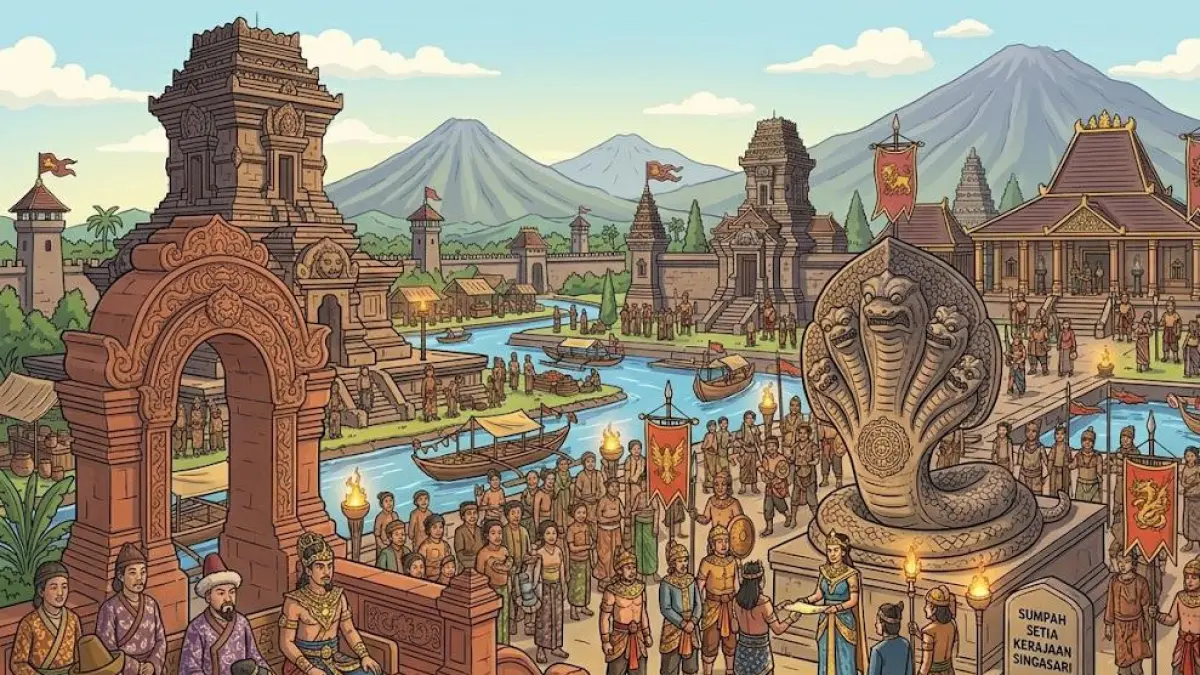
JAKARTA – The Singasari Kingdom history reveals a dramatic tale of ambition, betrayal, and power, tracing how a commoner named Ken Arok rose to establish one of Java’s most influential Hindu-Buddhist kingdoms in 1222, shaping the political and cultural trajectory of the Indonesian archipelago for decades.
The Singasari Kingdom history begins in East Java, where Tumapel—once a subordinate region of the Kadiri Kingdom—transformed into a dominant सत्ता under Ken Arok. His ascent, marked by calculated violence and strategic alliances, laid the foundation for a royal dynasty that would later influence the rise of Majapahit.
Historians often point to the Singasari Kingdom history as a turning point in Javanese civilization, blending mythology, political maneuvering, and documented inscriptions such as Kudadu and Mula Malurung to reconstruct its origins.
The Rise of Ken Arok and the Birth of Singasari
The emergence of Singasari is inseparable from the controversial figure of Ken Arok, whose story is preserved in ancient Javanese texts like Pararaton. According to the chronicle, Ken Arok was originally a commoner—raised by a thief—before entering the service of Tunggul Ametung, the local ruler of Tumapel.
Driven by ambition and desire, Ken Arok orchestrated the assassination of Tunggul Ametung using the legendary kris forged by Mpu Gandring. The act not only eliminated his rival but allowed him to marry Ken Dedes, widely believed to possess a divine aura. “Whoever marries Ken Dedes will produce rulers of Java,” a prophecy attributed to the Brahmin Lohgawe suggests.
By 1222, Ken Arok had consolidated power, defeating King Kertajaya of Kadiri with the support of Brahmins. He then declared himself ruler, adopting the title Sri Rajasa Batara Sang Amurwabumi—marking the formal beginning of the Singasari Kingdom.
Baca Juga: Moto3 Indonesia 2026 Jadi Sorotan Dunia, Veda Ega Pratama Bawa Harapan Baru di Grand Prix
Power, Expansion, and Dynastic Conflict
The Singasari Kingdom history is defined not only by its rise but also by internal bloodshed. Ken Arok’s reign, which lasted until 1247, ended when he was assassinated by Anusapati, the son of Tunggul Ametung. This fulfilled part of the infamous curse of Mpu Gandring’s kris, said to claim multiple lives across generations.
Subsequent rulers, including Tohjaya and Wisnuwardhana, continued the cycle of revenge and succession struggles. Historical records indicate that Anusapati ruled from 1247 to 1249, before being killed in retaliation by Tohjaya.
Stability only began to emerge under Wisnuwardhana, who ruled for more than two decades. His reign marked a consolidation phase, including the relocation of the capital to Singasari and the strengthening of political control over former Kadiri territories.
Baca Juga: Suzuki Ertiga Hybrid Ramai Disebut Bohong, Ternyata Ini Alasan Teknologi SHVS Bikin Konsumen Kecewa
Archaeological evidence supports these accounts. Temples such as Kidal and Jago, located in present-day Malang, are believed to be mortuary temples for Singasari rulers. While inscriptions directly confirming certain events remain limited, references in both Pararaton and Nagarakretagama provide overlapping narratives that historians consider credible.
Peak Glory and the Fall of a Kingdom
The height of the Singasari Kingdom history came under King Kertanegara, who ruled from 1272 to 1292. Under his leadership, Singasari expanded its influence beyond Java through the Pamalayu Expedition in 1275, targeting the Srivijaya region in Sumatra.
Kertanegara also pursued diplomatic alliances, including ties with the Kingdom of Champa, and sought to unify Hindu and Buddhist traditions. His reign is often described as the golden age of Singasari, with increased maritime trade and political reach across Southeast Asia.
Baca Juga: Moto3 Indonesia 2026 Makin Panas, Veda Ega Pratama Disebut Calon Masa Depan MotoGP Asia
However, his aggressive foreign policy came at a cost. With military forces deployed abroad, internal defenses weakened. In 1292, Jayakatwang, a descendant of the defeated Kadiri dynasty, launched a rebellion and assassinated Kertanegara during a palace attack.
The fall of Singasari was swift. Yet its legacy endured. In 1293, Raden Wijaya, Kertanegara’s son-in-law, defeated Jayakatwang with the strategic use of Mongol forces sent by Kublai Khan—before turning against them. He then established the Majapahit Kingdom, widely regarded as one of the greatest empires in Southeast Asian history.
A Legacy Shaped by Power and Prophecy
The Singasari Kingdom history stands as a powerful narrative of how ambition, prophecy, and violence shaped early Indonesian state formation. From Ken Arok’s unlikely rise to Kertanegara’s expansive vision, the kingdom’s story reflects both the fragility and resilience of power.
Baca Juga: Honda Team Asia Soroti Aksi Hebat Veda Ega Pratama, Dari Posisi 14 hingga Finis Keempat
As noted in historical chronicles, “Singasari was born from conflict and ended in betrayal,” yet its influence carried forward into the Majapahit era, leaving an enduring imprint on the region’s political and cultural identity.
Editor : Axsha ZazhikaSumber : youtube, Kitab Mawas Diri