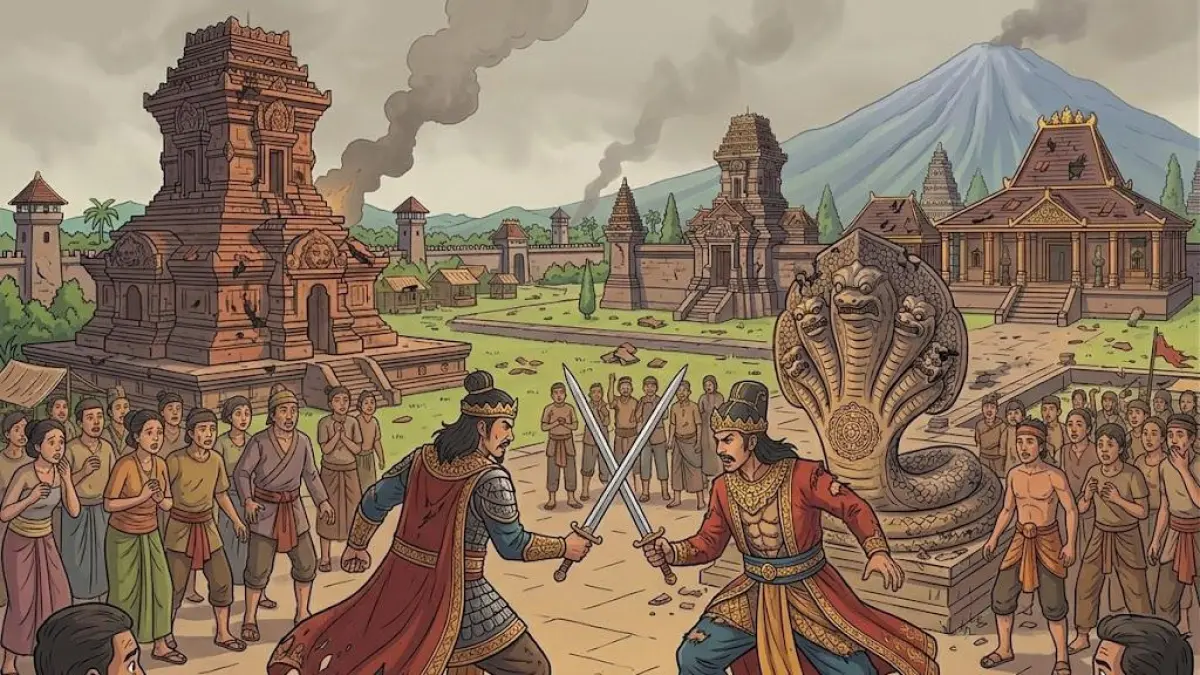
JAKARTA – The Majapahit collapse 1478 marks a निर्णायक turning point in Indonesian history, driven not by foreign invasion but by prolonged internal conflict, dynastic rivalry, and political fragmentation that ultimately dismantled one of Southeast Asia’s greatest empires.
The Majapahit collapse 1478 followed decades of instability after the Paregreg War, a succession conflict that culminated in 1401 with Prabu Wikramawardhana defeating Bhre Wirabhumi. While the victory temporarily unified the kingdom, it also exposed deep fractures within the royal family.
Historians widely view the Majapahit collapse 1478 as the final stage of a gradual decline, intensified by competing claims to the throne, shifting alliances, and the emergence of new regional powers such as Demak.
Baca Juga: Moto3 Indonesia 2026 Jadi Sorotan Dunia, Veda Ega Pratama Bawa Harapan Baru di Grand Prix
Internal Power Struggles and the Road to Collapse
The roots of Majapahit’s downfall can be traced to the aftermath of the Paregreg War. After Wikramawardhana’s death, the throne passed to his daughter, Queen Suhita, who ruled until 1447. Her reign is often described as a period of relative stability, but her death without a direct heir triggered a new succession crisis.
Power shifted to her brother, Sri Prabu Kertawijaya, who ruled from 1447 to 1451. Historical accounts note that Kertawijaya, also known as Raden Alif, attempted to maintain continuity in governance. However, his death led to a period of राजनीतिक vacuum.
Between 1453 and 1456, records suggest that Majapahit had no central ruler—an extraordinary development for a once-powerful empire. “For three years, no king sat on the Majapahit throne,” according to historical interpretations based on Pararaton and regional chronicles.
This instability allowed regional elites to assert control. Bhre Pamotan briefly ruled in Kediri but died under unclear circumstances. Later, Bhre Wengker rose to power and implemented policies that reshaped the kingdom’s political structure, including elevating Muslim relatives to key positions.
Competing Rulers and the Final Civil War
Tensions escalated in the late 15th century as rival factions openly challenged central authority. In 1468, Bhre Kertabhumi launched a rebellion, forcing the reigning king to flee and eventually declaring himself ruler in 1474.
At the same time, another claimant, Dyah Ranawijaya—also known as Girindrawardhana—emerged as a powerful विरोधी force. The existence of dual सत्ता created a fragmented political landscape, weakening Majapahit’s ability to maintain unity.
The decisive conflict came in 1478 during a major battle known as “Yuda lawan Majapahit.” Historical records, including inscriptions such as the Petak inscription, describe the event as a turning point. One passage notes, “Victory was achieved in the war against Majapahit,” signaling the fall of the রাজধানि and central authority.
Bhre Kertabhumi was killed in the conflict, effectively ending his claim and marking what many historians identify as the symbolic end of Majapahit in 1478.
Debates Over Demak and Raden Patah’s Role
The Majapahit collapse 1478 is often linked in popular narratives to the rise of Demak and its founder, Raden Patah. Some accounts claim that Demak forces directly attacked Majapahit, contributing to its سقوط.
However, historians caution against oversimplification. While texts such as Babad Tanah Jawi and Serat Darmogandul suggest Raden Patah’s involvement, there is no definitive evidence confirming a direct military assault that caused Majapahit’s fall.
Baca Juga: Hiroshi Aoyama Honda Jadi Kunci Kebangkitan Balap Asia, Strategi HRC Mulai Terlihat di MotoGP 2026
Instead, sources like Pararaton indicate that internal संघर्ष—particularly attacks led by rival princes such as Ranawijaya—played a more decisive role. “The king perished in the palace in 1478,” a passage suggests, emphasizing internal conflict over external conquest.
Following Majapahit’s decline, regional polities rapidly reorganized. Ranawijaya established a successor सत्ता in Kediri, while Demak emerged as a rising maritime शक्ति along Java’s northern coast.
Raden Patah himself, believed to have been born in 1455 in Palembang, later founded Demak as a center of trade and Islamic learning. Under his leadership, Demak grew into a प्रमुख शक्ति, signaling a broader transformation in Javanese politics and society.
Baca Juga: Veda Ega Pratama Makin Bersinar, Pembalap Muda Indonesia yang Disebut Calon Bintang MotoGP
A Kingdom Undone from Within
The Majapahit collapse 1478 underscores a broader historical lesson: powerful empires often fall not from external invasion but from internal division. Dynastic rivalries, कमजोर governance, and shifting allegiances gradually eroded Majapahit’s शक्ति from within.
While debates continue over the exact sequence of events, scholars agree that 1478 represents the moment when Majapahit ceased to function as a unified empire.
As one historical interpretation concludes, “Majapahit did not fall in a single blow—it collapsed under the weight of its own internal संघर्ष,” leaving behind a legacy that would shape the rise of new kingdoms such as Demak and redefine the political landscape of Java.
Editor : Axsha Zazhika