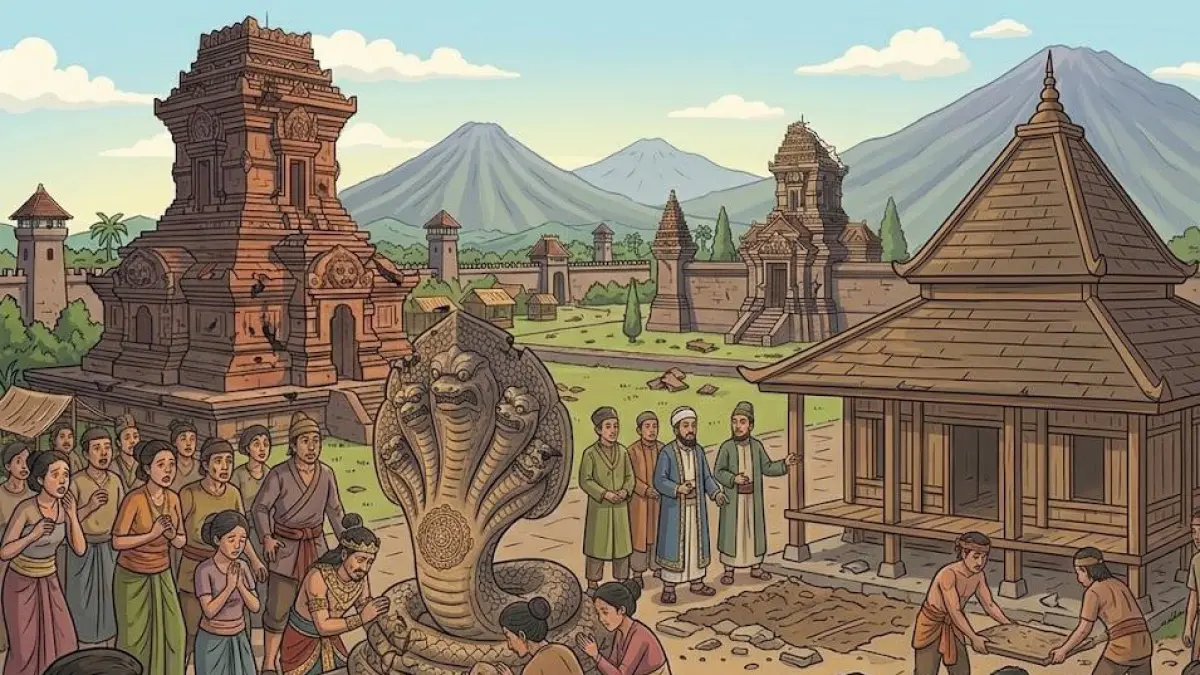
JAKARTA - The Majapahit Empire rise and fall reveals how one of Southeast Asia’s most powerful maritime kingdoms built a vast regional network before collapsing under internal conflict and shifting trade dynamics, ultimately shaping the political and cultural foundations of modern Indonesia.
The story of the Majapahit Empire rise and fall is not just a tale of conquest and decline, but a defining chapter in Southeast Asian history. At its peak in the 14th century, Majapahit controlled vast territories across the Indonesian archipelago and beyond, becoming a dominant thalassocracy centered in Trowulan, East Java.
Historians widely regard the Majapahit Empire rise and fall as a turning point that influenced trade, governance, and cultural identity in the region, leaving a legacy still visible in Indonesia’s modern national philosophy and territorial imagination.
The Rise of a Maritime Superpower
Majapahit’s ascent began in the late 13th century under Raden Wijaya, who established the kingdom in 1293 after defeating both local rivals and Mongol forces sent by the Yuan Dynasty. His strategic alliance with the Mongols—followed by a calculated betrayal—allowed him to consolidate power and crown himself as Kertarajasa Jayawardhana.
The empire’s strength grew through a combination of political strategy, military innovation, and control of key trade routes. Java’s fertile volcanic soil and proximity to the Malacca Strait—an ancient maritime Silk Road—gave Majapahit a critical economic advantage.
By the mid-14th century, under the leadership of Hayam Wuruk and his powerful prime minister Gajah Mada, Majapahit reached its golden age. Historical records such as the Nagarakretagama describe its influence spanning Sumatra, the Malay Peninsula, Borneo, Sulawesi, the Moluccas, and parts of the Philippines.
Baca Juga: Profil Veda Ega Pratama, Pembalap Muda Indonesia yang Viral dan Disebut Calon Bintang MotoGP
Gajah Mada’s famous “Sumpah Palapa” oath symbolized the ambition to unify Nusantara. “He vowed not to enjoy worldly pleasures before uniting the archipelago,” according to historical interpretations of the text, reflecting the empire’s expansionist vision.
Economic Power and Cultural Influence
At its height, Majapahit was not only a military force but also a thriving economic hub. The kingdom exported commodities such as rice, pepper, ivory, tin, cloves, and sandalwood, while acting as an intermediary in regional trade networks connecting China, India, Persia, and the Arab world.
Historical estimates suggest Majapahit could mobilize up to 200,000 troops with support from its vassal states, while maintaining a professional standing army of around 30,000 soldiers. Its naval power was equally formidable, with fleets reportedly consisting of hundreds of large “jong” ships.
Baca Juga: Veda Ega Pratama Makin Bersinar, Pembalap Muda Indonesia yang Digadang-Gadang Menuju MotoGP
Culturally, Majapahit was a center of religious tolerance and intellectual life. Hinduism and Buddhism coexisted, embodied in the philosophy “Bhinneka Tunggal Ika Tan Hana Dharma Mangrwa,” meaning “Unity in Diversity.” This concept later inspired Indonesia’s national motto.
The capital, Trowulan, became a cosmopolitan hub where merchants from China, Gujarat, Bengal, and even Europe interacted. The presence of figures like Odoric of Pordenone highlights the kingdom’s global connections.
Decline Driven by Internal Conflict and External Shifts
Despite its strength, the Majapahit Empire rise and fall ultimately turned on internal divisions. Following the death of Hayam Wuruk in the late 14th century, succession disputes weakened central authority.
The Paregreg War (1404–1406), a civil conflict between rival factions led by Wikramawardhana and Wirabhumi, drained resources and destabilized the empire. Although Wikramawardhana emerged victorious, the damage proved long-lasting.
Baca Juga: 5 Motor Listrik Terbaik 2026 dengan Jarak Tempuh Terjauh, Cocok untuk Harian dan Perjalanan Jauh
At the same time, external pressures mounted. The rise of the Malacca Sultanate in the early 15th century shifted regional trade dominance away from Java. Supported by Ming Dynasty China, Malacca became the new commercial hub of Southeast Asia.
Chinese expeditions led by Admiral Zheng He between 1405 and 1433 also strengthened Muslim communities along Java’s northern coast, accelerating the spread of Islam and reshaping the region’s political landscape.
By the late 15th century, Majapahit faced growing competition from emerging Islamic states, particularly Demak. Historical records suggest that by 1478, internal conflict—rather than a single external invasion—marked the effective end of Majapahit’s dominance.
Baca Juga: Rekomendasi Motor Listrik Terbaik 2026, Dari Harga Murah hingga Premium Berperforma Tinggi
Legacy and Historical Impact
The Majapahit Empire rise and fall continues to influence Indonesia’s national identity. Its territorial reach is often seen as a precursor to the modern Indonesian state, while its cultural principles remain embedded in the country’s ideology.
Even after its collapse, elements of Majapahit culture survived in regions such as Bali and eastern Java, where Hindu traditions continued to flourish. Meanwhile, the rise of Islamic sultanates marked a new era in Indonesian history.
Today, scholars emphasize that Majapahit’s downfall was not caused by religion alone but by a combination of political fragmentation, economic shifts, and leadership struggles.
In the end, the empire’s story stands as both a symbol of unity and a cautionary tale. As one historical interpretation suggests, “its decline underscores the importance of stability and wise governance in sustaining power.”
Editor : Axsha Zazhika