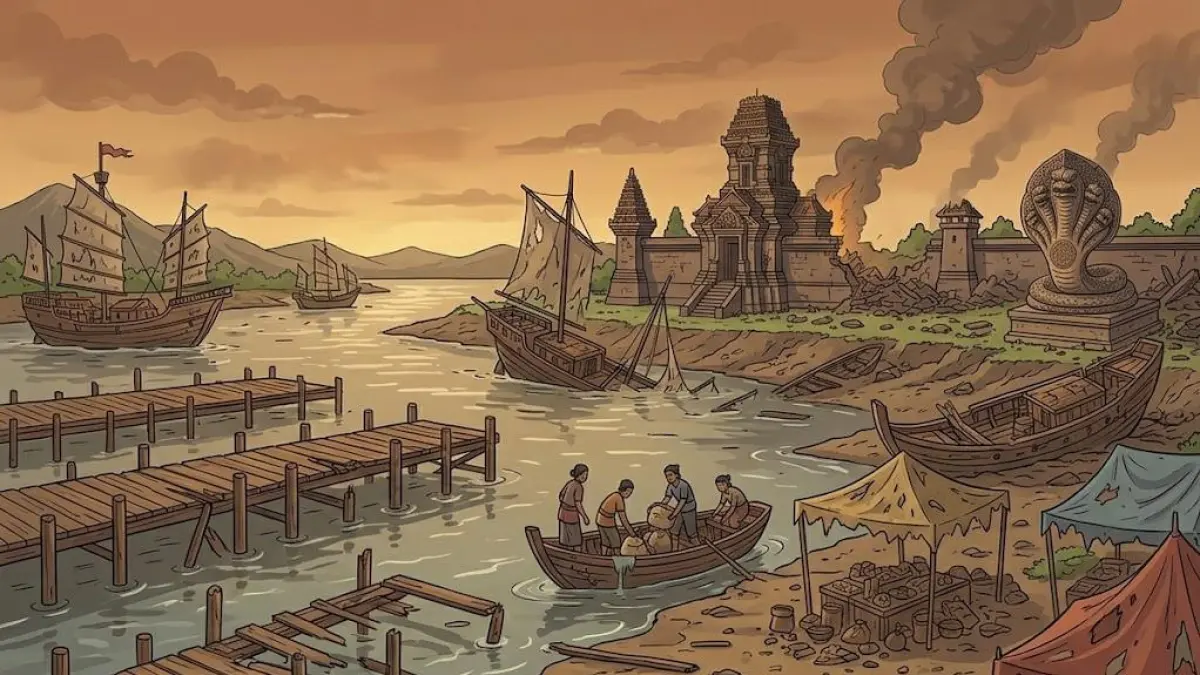
JAKARTA — The fall of Majapahit remains one of Southeast Asia’s most debated historical mysteries, as historians challenge the long-held belief that the powerful empire collapsed due to external attacks, instead pointing to deeper internal crises that ultimately dismantled one of Nusantara’s greatest civilizations.
For decades, popular narratives suggested that Majapahit fell after being defeated by Demak forces. However, historians now argue that the fall of Majapahit had already begun long before any external invasion, driven largely by political fragmentation, weakening authority, and a growing loss of public trust in the ruling elite.
The reassessment of the fall of Majapahit is based on primary sources, including inscriptions and foreign records, which offer a more nuanced understanding of how one of the region’s most influential empires unraveled despite its earlier golden age.
The Real Causes Behind the Fall of Majapahit
Historians emphasize that the fall of Majapahit cannot be attributed to a single event but rather a combination of internal and external factors. Contrary to the widely circulated Babad Tanah Jawi, which was written centuries later, primary historical evidence suggests that Majapahit had already lost its central power before Demak’s rise.
Research indicates that Majapahit’s authority was significantly weakened after being challenged by the Girindrawarddhana dynasty, which established its power base in Daha (modern-day Kediri). By the 16th century, Demak’s military campaigns targeted Daha—not Majapahit itself—marking the end of the classical Javanese era.
Inscriptions such as Jiyu and Petak reveal claims of authority by rulers like Dyah Ranawijaya, who declared control over regions including Wilwatikta, Janggala, and Panjalu. Historians interpret these claims as signs of political fragmentation, suggesting that legitimacy was contested and no longer universally recognized.
Internal Collapse: Loss of Trust and Weak Governance
Beyond political shifts, historians identify internal decay as the most decisive factor in the fall of Majapahit. Portuguese chronicler Tome Pires, in Suma Oriental, recorded that by the empire’s final phase, “the people of Java no longer trusted the king’s commands” because they were no longer masters of their own land.
This marked a stark contrast with Majapahit’s golden age under King Hayam Wuruk. Historical records such as the Nagarakertagama describe a period when rulers maintained close relationships with their জনগ, traveling across regions and interacting directly with communities.
During that era, governance was characterized by strong law enforcement and public welfare. Legal codes like Kutara Manawa enforced strict regulations, including penalties for leaving land unproductive and severe punishments for theft, particularly crimes committed at night.
Baca Juga: Polytron Fox 350 Resmi Meluncur, Motor Listrik Bergaya Maxi Scooter Ini Dijual Mulai Rp15 Jutaan
However, in its final years, governance deteriorated. Leaders became increasingly detached, focusing on court life and internal conflicts. Reports describe rulers prioritizing hunting expeditions and leisure while neglecting administrative responsibilities.
This disconnect created fear rather than loyalty. Accounts suggest that ordinary citizens were even prohibited from being present on roads used by the king, illustrating a widening gap between the state and its people.
External Pressure and the Final Blow
While internal decline played a central role, external pressures still contributed to the fall of Majapahit. The rise of Islamic coastal states, including Demak, intensified regional competition and shifted economic and political dynamics in Java.
Baca Juga: Profil Veda Ega Pratama, Pembalap Muda Indonesia yang Viral dan Disebut Calon Bintang MotoGP
Yet historians argue that these external forces acted more as a “final blow” rather than the root cause. Majapahit had previously survived foreign threats—including Mongol incursions during earlier reigns—thanks to strong internal unity and public support.
In contrast, during its final phase, the empire faced internal divisions such as the Paregreg civil war, which led to dual centers of power and confusion over political allegiance. This fragmentation weakened the state’s ability to respond effectively to external challenges.
Lessons from the Fall of Majapahit
The fall of Majapahit offers enduring lessons about governance and state resilience. Historians highlight that the empire’s strength once lay in its ability to maintain trust, enforce laws fairly, and ensure public welfare.
Baca Juga: Motor Listrik Terbaik 2026 Paling Dicari, Ini 5 Pilihan Paling Irit dan Canggih untuk Harian
When those foundations eroded, even a powerful empire could not sustain itself. As one historical interpretation suggests, the relationship between the state and its people is like a forest and a lion—each depends on the other for survival.
Ultimately, the collapse of Majapahit was not sudden but gradual, rooted in declining legitimacy and broken trust. External attacks merely accelerated a process that had already begun from within.
Editor : Axsha Zazhika