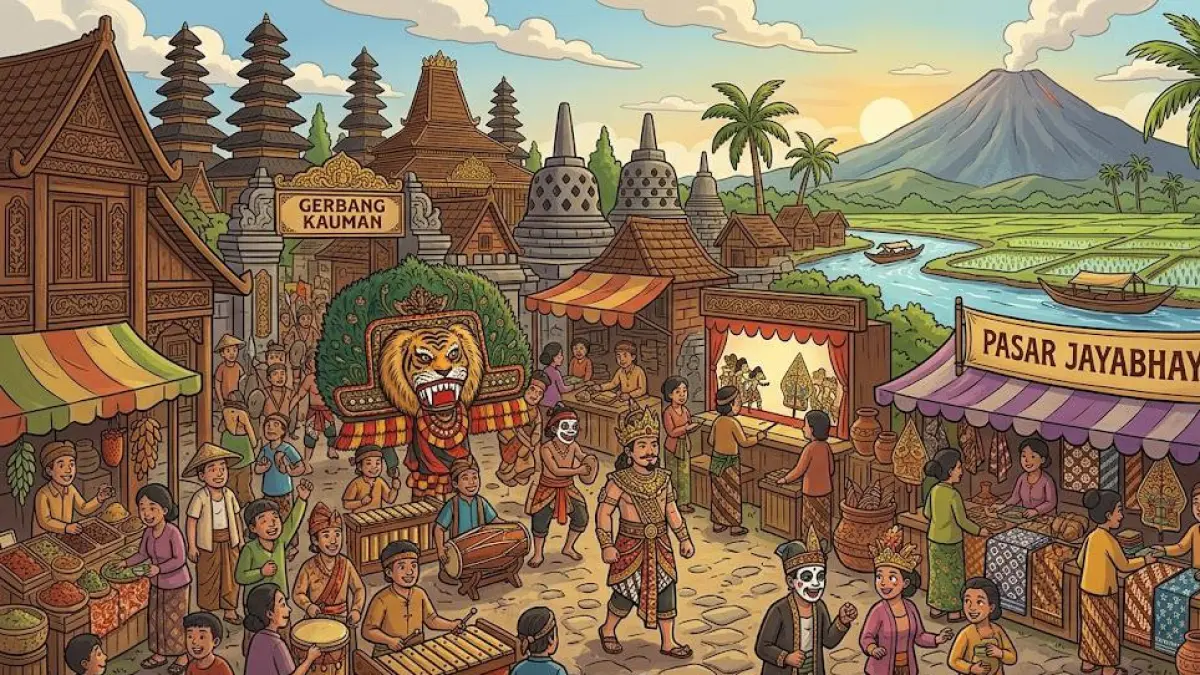
JAKARTA - Kediri Kingdom history reveals how one of Southeast Asia’s most influential cultural powers rose to prominence in East Java before collapsing in 1222, leaving behind a lasting legacy in literature, governance, and trade that continues to shape Indonesian identity centuries later.
The Kediri Kingdom history is defined by its transformation into a center of literature and culture between the 11th and 13th centuries, supported by strategic trade routes and visionary rulers. At its peak, Kediri was not only a political force but also a cultural beacon across the archipelago.
Understanding Kediri Kingdom history offers insight into how early Javanese civilization balanced power, culture, and economy—before internal conflict and rebellion brought its dominance to an end.
Rise of Kediri as a Cultural Powerhouse
The Kediri Kingdom, also known as Panjalu, was established around 1042 following the division of the Medang Kingdom by King Airlangga. The split created two rival states—Janggala and Panjalu—intended to prevent succession conflict between his heirs.
Located along the Brantas River in present-day East Java, Kediri quickly developed into a major economic and cultural hub. The river served as a critical trade artery, connecting inland regions with coastal ports and facilitating the movement of spices, gold, and other commodities.
Kediri reached its golden age during the 12th century, particularly under King Jayabaya. Widely regarded as a wise and visionary ruler, Jayabaya is associated with prosperity and stability, as well as prophetic texts known as the “Jayabaya prophecies,” which remain embedded in Javanese cultural tradition.
Literature, Economy, and Military Expansion
Kediri’s most enduring legacy lies in its literary achievements. The kingdom became a center for Old Javanese literature, producing monumental works such as Kakawin Bharatayuddha, written by Empu Sedah and completed by Empu Panuluh during Jayabaya’s reign.
This epic, inspired by the Mahabharata, narrates the great war between the Pandava and Kurava clans and is considered one of Indonesia’s most significant literary works. Other texts, including Hariwangsa and Gatotkacasraya, further highlight Kediri’s role in shaping classical Javanese literature.
Beyond literature, Kediri fostered vibrant cultural traditions. Performing arts such as dance, music, and shadow puppetry (wayang kulit) flourished under royal patronage, reinforcing the kingdom’s identity as a cultural stronghold.
Economically, Kediri benefited from its strategic position along the Brantas River. Control over trade routes allowed it to dominate regional commerce, generating substantial wealth. This economic strength supported military expansion, enabling Kediri to extend its influence across East Java and even into Bali.
Internal Conflict and the Collapse of Kediri
Despite its achievements, Kediri faced growing internal tensions that eventually led to its downfall. Power struggles within the royal family, combined with external pressures, weakened the kingdom’s stability.
The निर्णsing moment came in 1222 with the Battle of Ganter, where King Kertajaya confronted Ken Arok, the founder of the Singhasari Kingdom. The conflict was fueled by religious disputes, as Kertajaya was accused of oppressing Brahmins and violating Hindu-Buddhist norms.
Backed by Brahmin support and military alliances, Ken Arok’s forces defeated Kediri’s army. The loss marked the end of Kediri’s dominance and the rise of Singhasari as a new regional power.
“The defeat of Kertajaya in 1222 effectively ended Kediri’s rule,” according to historical accounts, underscoring the decisive nature of the battle.
Legacy and Lasting Influence
Although Kediri ceased to exist as a political power, its cultural and intellectual influence endured. Successor kingdoms such as Singhasari and later Majapahit inherited and developed Kediri’s literary and administrative traditions.
Kediri’s literary works remain foundational in Javanese culture, continuing to influence storytelling, spirituality, and artistic expression. Traditional arts such as wayang kulit and classical music still carry elements rooted in the Kediri era.
Moreover, Kediri’s governance model and the leadership ideals exemplified by figures like Jayabaya became references for future rulers in the region.
The Kediri Kingdom history ultimately reflects a broader narrative of rise and decline—where cultural brilliance and economic strength were undermined by internal discord and leadership crises.
Even after its fall, Kediri’s legacy persists, demonstrating how cultural achievements can outlast political power and continue shaping societies for generations.
Editor : Axsha Zazhika