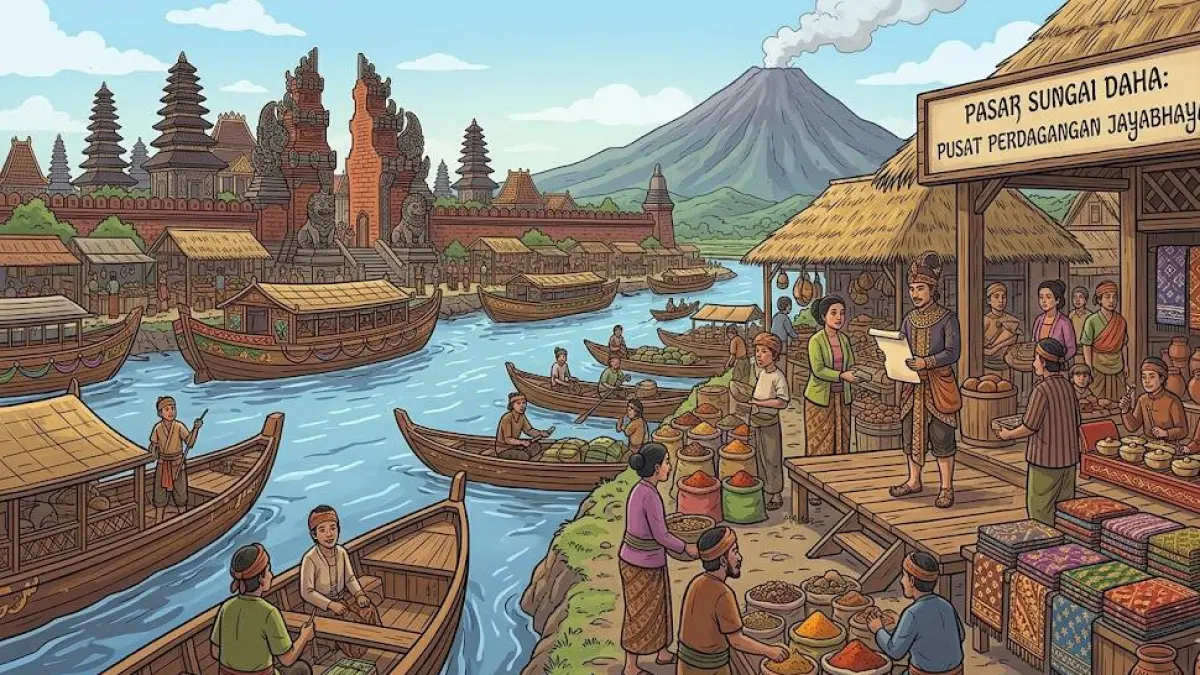
JAKARTA – The Kediri Kingdom history traces the rise of a powerful Hindu-Buddhist state in East Java from 1042 to 1222, emerging from the تقسیم of Airlangga’s kingdom before reaching a golden age under King Jayabaya and ultimately collapsing after a निर्णायक conflict that reshaped Java’s political landscape.
The Kediri Kingdom history begins when King Airlangga divided his realm in November 1042 to prevent a succession war between his sons. This decision created two rival states—Panjalu, later known as Kediri, and Janggala—marking the start of a new era in Javanese political history.
Centered in Daha, now part of modern Kediri city, the Kediri Kingdom history reflects a الدولة that evolved into a major economic and cultural hub, controlling agricultural wealth and regional trade routes while producing influential literary works rooted in Hindu epics.
Formation and Consolidation After Airlangga’s Division
Kediri, also called Panjalu, was established as the western successor state of Airlangga’s former kingdom, with Sri Samarawijaya ruling from the newly established capital of Daha. Meanwhile, his brother Mapanji Garasakan governed Janggala from Kahuripan.
Historical inscriptions, including the Pamotan inscription dated 1042, confirm the use of the name Dahanapura—meaning “city of fire”—as the royal center. Over time, Panjalu emerged as the dominant power, eventually absorbing Janggala after prolonged rivalry.
By the mid-12th century, Kediri had unified much of Java. The kingdom’s official slogan, recorded in the Ngantang inscription of 1135, declared “Panjalu Jayati,” or “Panjalu Triumphs,” symbolizing victory over its eastern rival.
Baca Juga: Profil Veda Ega Pratama, Pembalap Muda Indonesia yang Viral dan Disebut Calon Bintang MotoGP
Golden Age Under Jayabaya: Trade, Literature, and Regional Influence
The Kediri Kingdom history reached its peak during the reign of King Jayabaya in the 12th century. Under his rule, Kediri expanded its territory across Java and exerted influence over parts of the archipelago, even challenging the declining dominance of Sriwijaya in Sumatra.
Chinese records from 1178, particularly Lingwai Daida by Chou K’u-fei, ranked Java among the wealthiest regions after China and the Arab world. “The richest lands after China are Arabia, Java, and Sumatra,” the chronicle noted, highlighting Kediri’s economic prominence.
Daha’s strategic location along the Brantas River allowed Kediri to control inland and maritime trade, particularly in spices. The kingdom maintained trade links with China and India, while its economy was partially monetized using silver coins issued by the royal court.
Baca Juga: Veda Ega Pratama Makin Bersinar, Pembalap Muda Indonesia yang Digadang-Gadang Menuju MotoGP
Culturally, Kediri became a center of classical Javanese literature. Works inspired by Hindu epics such as the Mahabharata and Ramayana flourished, reflecting strong religious and intellectual connections with India. Archaeological findings at Tondowongso, discovered in 2007, further подтверждают the kingdom’s advanced urban and religious structures.
Collapse After Religious Conflict and the Ganter War
Despite its achievements, the Kediri Kingdom history ended in 1222 following internal unrest and external rebellion. The final ruler, King Kertajaya, became embroiled in conflict with Brahmins, who opposed his policies and sought protection from Ken Arok, the ruler of Tumapel.
The dispute escalated into open war. The decisive confrontation, known as the Battle of Ganter, took place near present-day Kediri. Ken Arok’s forces, supported by religious leaders and local القوى, defeated Kertajaya’s الجيش, effectively ending Kediri’s dominance.
Historical sources such as Pararaton and Negarakertagama record that Kediri fell under the control of Tumapel, later known as Singhasari. “With the defeat of Kertajaya, the Kediri Kingdom ceased to exist as an independent power,” the chronicles indicate.
Following the سقوط, Kediri became a subordinate region within Singhasari. Its royal lineage continued through local rulers, including Jayasabha and Jayakatwang, the latter briefly reviving Kediri in 1292 after overthrowing Singhasari’s Kertanegara.
However, this revival was short-lived. In 1293, a combined force of Mongol troops sent by Kublai Khan and the قوات of Raden Wijaya defeated Jayakatwang, permanently ending Kediri’s political independence.
Legacy Beyond Its Fall
The Kediri Kingdom history remains significant in Southeast Asian historiography for its contributions to governance, trade, and literature. Its irrigation systems, inherited from Airlangga, supported agricultural productivity, while its cultural output influenced later kingdoms such as Singhasari and Majapahit.
Even after its سقوط, Kediri’s legacy endured in Javanese traditions, literary works, and administrative systems, forming a crucial foundation for subsequent Indonesian civilizations.
In the end, Kediri’s story is one of transformation—from a divided kingdom to a regional powerhouse, and finally to a legacy carried forward by the empires that followed.
Editor : Axsha Zazhika