
Why Did the Majapahit Empire Collapse So Quickly? Historians Reveal the Real Causes Behind Its Fall
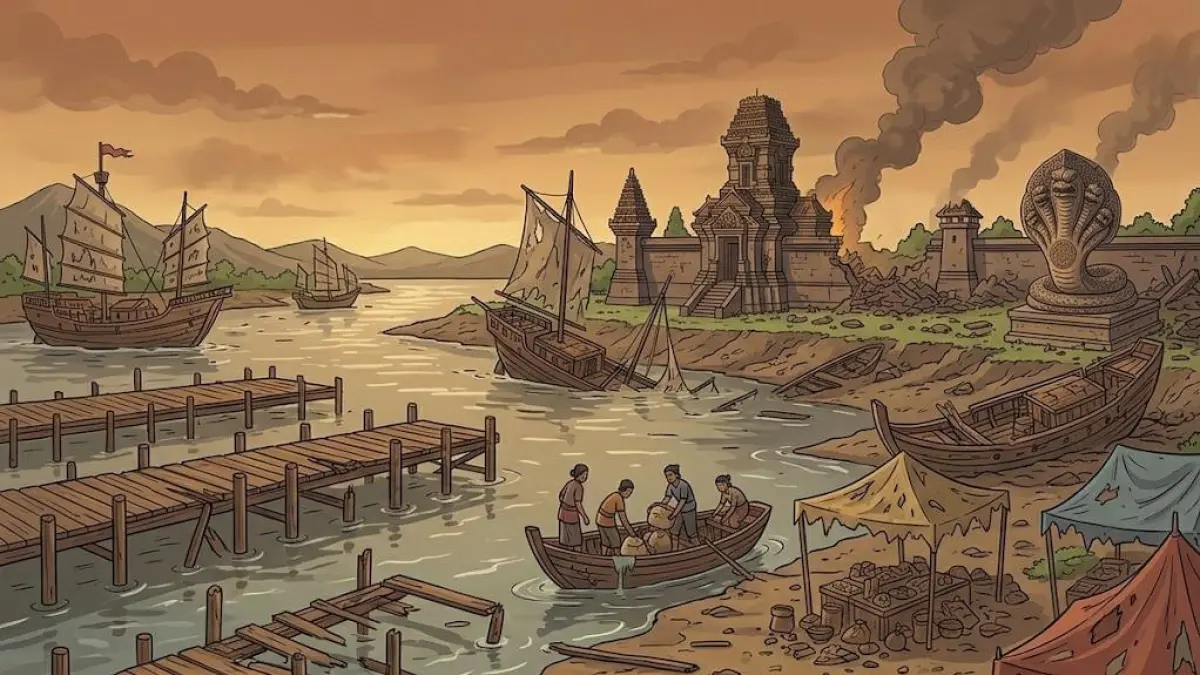
JAKARTA — The fall of Majapahit remains one of Southeast Asia’s most debated historical mysteries, as historians challenge the long-held belief that the powerful empire collapsed due to external attacks, instead pointing to deeper internal crises that ultimately dismantled one of Nusantara’s greatest civilizations.
For decades, popular narratives suggested that Majapahit fell after being defeated by Demak forces. However, historians now argue that the fall of Majapahit had already begun long before any external invasion, driven largely by political fragmentation, weakening authority, and a growing loss of public trust in the ruling elite.
The reassessment of the fall of Majapahit is based on primary sources, including inscriptions and foreign records, which offer a more nuanced understanding of how one of the region’s most influential empires unraveled despite its earlier golden age.
The Real Causes Behind the Fall of Majapahit
Historians emphasize that the fall of Majapahit cannot be attributed to a single event but rather a combination of internal and external factors. Contrary to the widely circulated Babad Tanah Jawi, which was written centuries later, primary historical evidence suggests that Majapahit had already lost its central power before Demak’s rise.
Research indicates that Majapahit’s authority was significantly weakened after being challenged by the Girindrawarddhana dynasty, which established its power base in Daha (modern-day Kediri). By the 16th century, Demak’s military campaigns targeted Daha—not Majapahit itself—marking the end of the classical Javanese era.
Inscriptions such as Jiyu and Petak reveal claims of authority by rulers like Dyah Ranawijaya, who declared control over regions including Wilwatikta, Janggala, and Panjalu. Historians interpret these claims as signs of political fragmentation, suggesting that legitimacy was contested and no longer universally recognized.
Internal Collapse: Loss of Trust and Weak Governance
Beyond political shifts, historians identify internal decay as the most decisive factor in the fall of Majapahit. Portuguese chronicler Tome Pires, in Suma Oriental, recorded that by the empire’s final phase, “the people of Java no longer trusted the king’s commands” because they were no longer masters of their own land.