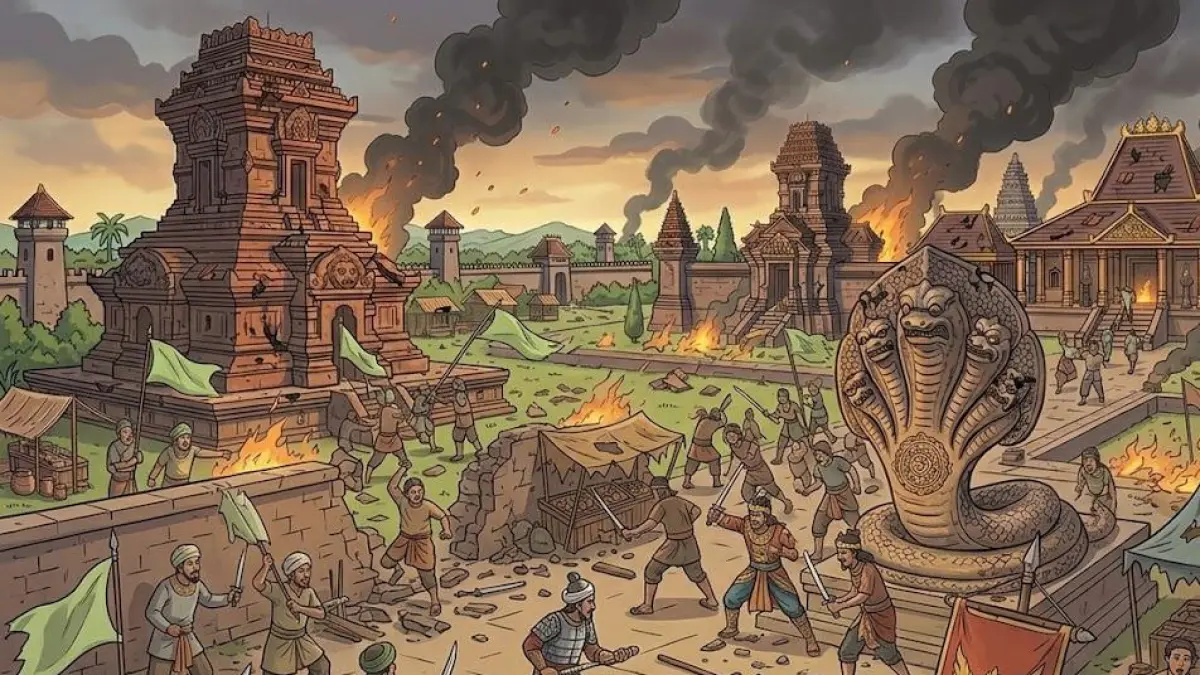
JAKARTA - The Majapahit Empire legacy continues to shape modern Indonesia as historians revisit a long-standing question: where did the people of Majapahit go after the kingdom’s dramatic decline in the 15th century? New interpretations highlight migration, cultural transformation, and political shifts that reshaped Southeast Asia.
The Majapahit Empire legacy is increasingly understood not as a disappearance, but as a diffusion of people, power, and traditions across the Indonesian archipelago. Following the deaths of key leaders such as Hayam Wuruk and Gajah Mada, internal conflict and external pressures triggered one of the region’s most significant historical transitions.
Experts note that the Majapahit Empire legacy survived through migration patterns, cultural preservation, and the emergence of new political centers, particularly in Bali and along Java’s northern coast.
Baca Juga: Profil Veda Ega Pratama, Pembalap Muda Indonesia yang Viral dan Disebut Calon Bintang MotoGP
Collapse Triggered by Internal Conflict and Power Struggles
The decline of Majapahit began shortly after its golden age in the 14th century, when the kingdom controlled vast ტერიტორი spanning Sumatra, the Malay Peninsula, and eastern Indonesia. According to historical accounts, the death of Hayam Wuruk in 1389 marked a turning point.
Without strong central leadership, succession disputes escalated into open conflict. The Paregreg War—fought between rival royal factions including Wirabhumi and Wikramawardhana—exposed deep fractures within the ruling elite.
“Majapahit was not defeated by foreign invasion, but by internal disintegration,” historians often conclude, pointing to the civil war as a decisive factor in weakening the state.
Baca Juga: Veda Ega Pratama Makin Bersinar, Pembalap Muda Indonesia yang Digadang-Gadang Menuju MotoGP
At the same time, regional rulers began asserting independence. Former vassal states gradually broke away, while trade disruptions and heavy taxation further destabilized the economy. By the early 15th century, Majapahit’s once-dominant military had been significantly weakened.
Rise of Demak and Shifting Religious Landscape
As Majapahit faltered, a new power emerged along Java’s northern coast: the Sultanate of Demak. Unlike Majapahit’s Hindu-Buddhist foundation, Demak was rooted in Islam, which had spread through trade networks connecting the archipelago to Gujarat, Arabia, and China.
Raden Patah, believed to have royal Majapahit lineage, established Demak as a political and economic force. By leveraging trade wealth and religious influence, Demak attracted merchants, former officials, and even soldiers from the declining Majapahit court.
Baca Juga: Motor Listrik Terbaik 2026 Paling Dicari, Ini 5 Pilihan Paling Irit dan Canggih untuk Harian
This transition was not purely ideological. Many individuals shifted allegiance for pragmatic reasons. For traders, Demak offered stability and access to growing maritime networks. For displaced elites, it presented an opportunity to retain influence under a new system.
By the mid-15th century, Demak had effectively replaced Majapahit as the dominant power in Java, marking a broader shift from Hindu-Buddhist kingdoms to Islamic sultanates across the region.
Migration, Cultural Survival, and the Bali Connection
One of the most enduring aspects of the Majapahit Empire legacy lies in the migration of its people. As political control collapsed, nobles, priests, artists, and commoners relocated to safer regions—most notably Bali.
Historical narratives describe waves of migration carrying manuscripts, religious texts, royal heirlooms, and artistic traditions across the Bali Strait. These migrants did not arrive in an empty land; instead, they integrated with existing Balinese society, creating a unique cultural synthesis.
Today, Bali’s Hindu traditions, temple architecture, and classical dances—such as gambuh and topeng—are widely regarded as living reflections of Majapahit heritage. The use of Kawi language in rituals and the continuation of caste-like social structures further reinforce this connection.
Beyond Bali, smaller groups retreated into remote areas of Java, forming isolated communities that preserved elements of Majapahit culture through oral tradition, ritual practices, and hidden manuscripts.
Lasting Impact Across Indonesia
The Majapahit Empire legacy also spread through political adaptation. Several post-Majapahit kingdoms and sultanates claimed lineage from the fallen empire to legitimize their rule. In regions such as Blambangan in East Java, Hindu traditions persisted longer than in other parts of the island.
Cultural elements—from batik motifs and wayang performances to kris symbolism—continue to carry philosophical and aesthetic influences rooted in the Majapahit era. Even Indonesia’s national motto, “Bhinneka Tunggal Ika,” originates from a Majapahit-era text.
Modern historians argue that Majapahit’s concept of a maritime state connecting diverse islands laid the foundation for Indonesia’s contemporary identity as an archipelagic nation.
A Civilization That Never Truly Disappeared
Rather than vanishing, the people of Majapahit adapted to a changing world—merging into new political systems, migrating across regions, and preserving their traditions in subtle but enduring ways.
The fall of the kingdom marked the end of a political entity, but not its civilization. As one historical interpretation suggests, “Majapahit did not collapse overnight—it transformed, quietly continuing through its people.”
Today, the Majapahit Empire legacy remains deeply embedded in Indonesia’s culture, identity, and historical consciousness, proving that even the greatest empires do not simply disappear—they evolve.
Editor : Axsha Zazhika