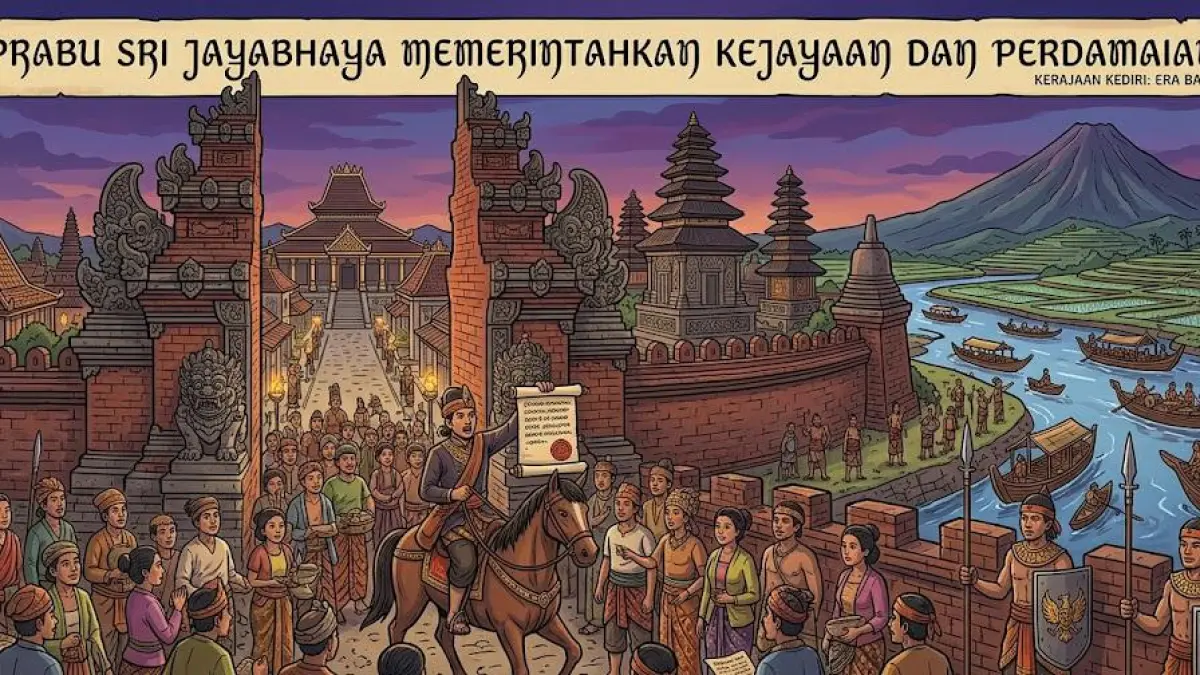
JAKARTA – The Kediri Kingdom history highlights one of Southeast Asia’s most influential cultural and literary civilizations, rising in East Java between 1042 and 1222 before collapsing after a निर्णu conflict that reshaped regional power. Known as a hub of literature, trade, and governance, Kediri’s legacy continues to shape Indonesian cultural identity centuries later.
The Kediri Kingdom history begins with the division of Airlangga’s realm in 1042, creating Panjalu (Kediri) and Janggala to avoid civil war. Centered in Daha—modern-day Kediri—the kingdom rapidly emerged as a dominant force in Java, controlling trade routes along the Brantas River and fostering a flourishing intellectual culture.
At its peak, the Kediri Kingdom history reflects a powerful state that not only dominated East Java politically but also became a beacon of classical Javanese literature, producing works that still influence Indonesian arts and philosophy today.
Baca Juga: Polygon Siskiu T7E dan T6E Resmi Dirilis, E-MTB Baru Bermotor Shimano Ini Siap Hajar Segala Medan
Rise of Kediri as a Cultural and Political Power
The Kediri Kingdom, also known as Panjalu, grew into a major regional power during the 12th century under rulers such as King Jayabaya. Historical records, including the Chinese chronicle Lingwai Daida (1178), describe Java—under Kediri—as one of the richest regions in the world after China.
“Panjalu Jayati,” meaning “Panjalu Triumphs,” became a defining slogan during Jayabaya’s reign, marking Kediri’s victory over its rival Janggala and the consolidation of power across Java.
Kediri’s राजधानी, Daha, strategically located along the Brantas River, became a critical trade hub linking inland agricultural areas with coastal ports. This position allowed the kingdom to control the flow of spices, gold, and other valuable commodities, significantly boosting its economy.
Golden Age of Literature, Economy, and Military Expansion
The Kediri Kingdom history is inseparable from its literary achievements. During Jayabaya’s reign in the mid-12th century, the kingdom produced the epic Kakawin Bharatayuddha in 1157, written by Mpu Sedah and completed by Mpu Panuluh. The text, inspired by the Indian Mahabharata, symbolized political victory and moral order.
Other notable works include Hariwangsa, Gatotkacasraya, and Smaradahana, reflecting strong Hindu influence, particularly Vishnuism. These literary achievements positioned Kediri as a leading intellectual center in the archipelago.
Economically, Kediri thrived through agriculture, trade, and taxation systems. Chinese accounts from 1225 describe a prosperous society with organized governance, where crimes were punished with fines rather than corporal punishment—an advanced legal approach for its time.
Militarily, Kediri expanded its influence across much of Java and beyond, with evidence suggesting its reach extended to Bali and parts of Kalimantan. The kingdom also maintained a capable naval force, reinforcing its role in regional trade and security.
Collapse After Internal Conflict and the Ganter War
Despite its achievements, the Kediri Kingdom history ended abruptly in 1222 following internal unrest and external rebellion. The final ruler, King Kertajaya, faced opposition from Brahmins after allegedly demanding divine worship, a move considered a violation of religious norms.
The conflict escalated when the Brahmins sought protection from Ken Arok, ruler of Tumapel. Backed by religious leaders and local support, Ken Arok launched a rebellion against Kediri.
Baca Juga: Polygon Tambora AE GRX Resmi Meluncur, Sepeda Gravel E-Bike Rp68 Juta Ini Bisa Ngebut 45 Km/Jam
The निर्णायक clash, known as the Battle of Ganter in 1222, resulted in Kediri’s defeat. Historical sources such as Pararaton suggest that Kertajaya either died in battle or shortly afterward, marking the نهاية of Kediri as a dominant kingdom.
Following the collapse, Kediri became part of the Singhasari Kingdom, later absorbed into the Majapahit Empire. Although its political power faded, its cultural influence endured.
Enduring Legacy in Indonesian Culture
The Kediri Kingdom history continues to resonate through its literary, cultural, and administrative contributions. Many classical Javanese texts produced during this era remain foundational to Indonesian literature and performing arts, including wayang traditions.
Archaeological discoveries, such as the Tondowongso site uncovered in 2007, provide further insight into Kediri’s historical significance and ongoing relevance in academic research.
Even after its fall, Kediri’s governance models and cultural frameworks influenced successor kingdoms, particularly Singhasari and Majapahit, shaping the broader trajectory of Indonesian civilization.
In the end, the Kediri Kingdom stands as more than a political entity—it represents a golden era of intellectual and cultural achievement whose echoes persist in modern Indonesia.
Editor : Axsha Zazhika